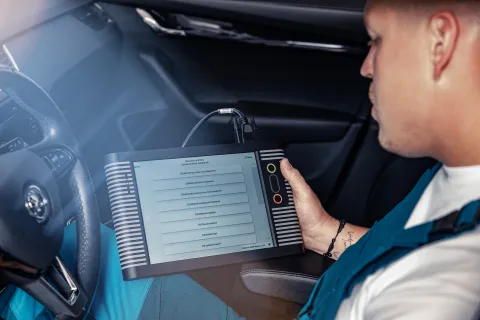
Two identical cars may no longer be diagnostically identical
Workshop technicians traditionally identify vehicles by manufacturer, model, model year, engine and equipment. If two similarly equipped vehicles of the same model are parked next to each other, it is natural to expect their ECUs to behave in essentially the same way during diagnostics. With modern vehicles, that assumption is becoming less reliable.
Vehicle manufacturers can update software throughout the vehicle lifecycle. An update may be installed during a dealer visit, through a service campaign or increasingly over the air. Volkswagen, for example, has described an OTA architecture on its MEB platform capable of reaching software in dozens of control units. BMW likewise describes remote software upgrades across functional domains including infotainment, driver assistance and body and comfort systems.
The physical ECU may remain unchanged. The part number may look the same. The connector is the same. Communication still runs over the same network. To the mechanic, the vehicle looks unchanged. But internally, the ECU is running different software. And software defines a substantial part of the ECU's diagnostic behaviour.
What exactly is an ECU variant?
Professional diagnostics does not simply operate with a database saying “Bosch engine ECU – supported”. The tester needs to understand the exact diagnostic implementation used by that ECU.
ODX, or Open Diagnostic Data Exchange according to ISO 22901-1, is an automotive industry standard specifically designed to describe diagnostic data. It can contain diagnostic services and their requests and responses, Diagnostic Trouble Codes, measured data, flash programming, variant coding and other diagnostic capabilities.
Crucially, the standard also explicitly supports different ECU variants.
ASAM describes how a diagnostic tester can read ECU identification data using normal diagnostic requests and compare the returned information against identification patterns belonging to individual ECU variants. Only after a match is found does the tester know which diagnostic description should be used.
That technical process is what may sit behind a very simple workshop message such as “unknown ECU variant”.
Why “it is still the same ECU” is not enough
Because diagnostics is not only about successfully sending and receiving bytes. Receiving a response from an ECU is one thing. Knowing exactly what that response means is another.
Imagine that a tester requests a measured parameter and receives two bytes in return. Without the correct diagnostic description, those bytes alone do not tell the technician whether the value represents pressure, temperature, RPM, voltage, percentage or a status flag. The diagnostic database contains the conversion rules, scaling, units and descriptions needed to turn the raw response into something meaningful.
Softing describes ODX precisely in this context: diagnostic communication is converted from hexadecimal data into physical and human-readable values, and individual ECU variants form part of that data model.
This means that selecting the wrong variant does not always produce a clean error message. A more dangerous situation is when the ECU responds successfully and the tester interprets the response using the definitions belonging to another software variant. The technician can then see a value that looks perfectly plausible but means something different in the actual ECU software.
With DTCs (Diagnostic Trouble Codes), a similar issue can occur with the textual description, subtype, snapshot information or extended diagnostic data associated with the code.

Service functions are even more sensitive to ECU variants
The effect becomes much more obvious with active diagnostic functions. An actuator test, calibration, adaptation, basic setting or coding operation is rarely a universal command such as “switch valve on”. Behind the button on the screen may be a precise sequence involving diagnostic-session changes, security access, particular service identifiers, routine parameters, prerequisite checks and interpretation of the ECU's response.
If a new ECU software version changes the routine, identifier, parameter structure or execution conditions, an older diagnostic description may stop working. The workshop may see a negative ECU response, a “function not supported” message or simply a routine that no longer performs the expected action.
Nothing may be physically wrong with the car or with the diagnostic interface. The tester's database simply may not yet know the new software variant.
Can an OEM update therefore “break the diagnostic tool”?
A more technically accurate statement is that an OEM software update can create a new ECU state or variant that an existing aftermarket diagnostic database does not yet recognise or cannot identify unambiguously.
Not every software update changes the diagnostic interface. Many updates fix internal control algorithms while leaving diagnostics largely unchanged. But changes are possible. Softing notes that diagnostic databases of modern vehicles become increasingly complex throughout the vehicle lifecycle because of additional variants, maintenance measures and functional extensions.
Mercedes-Benz provides another useful illustration of the general principle. The company states that the quality and transmission behaviour of data from its telematics control units can depend on software status, and that outdated software can lead to incorrect or inconsistent transmission behaviour. This is not specifically a workshop-diagnostic example, but it demonstrates the important underlying fact: changing ECU software can change communication behaviour without changing the hardware.
What DevCom means by automatic ECU software variant detection
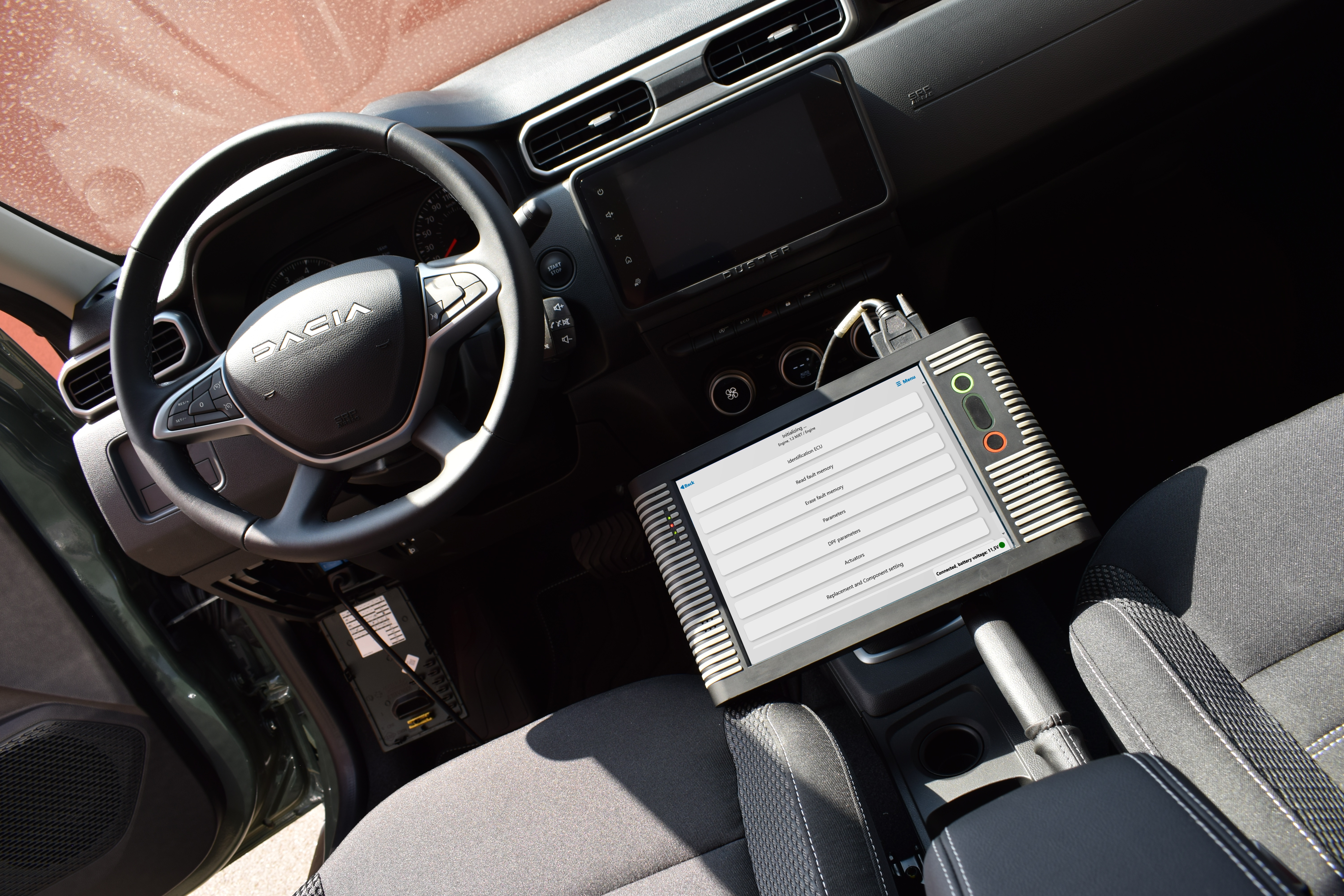
This is the problem DevCom addresses with a function internally described as automatic ECU software variant detection. The goal is not merely to determine that an engine ECU, ABS controller or body module exists in the vehicle.
The diagnostic system attempts to use the ECU's identification data to determine the exact software variant and then assign the correct diagnostic dataset to it. This becomes especially important where one hardware family exists with many different software releases.
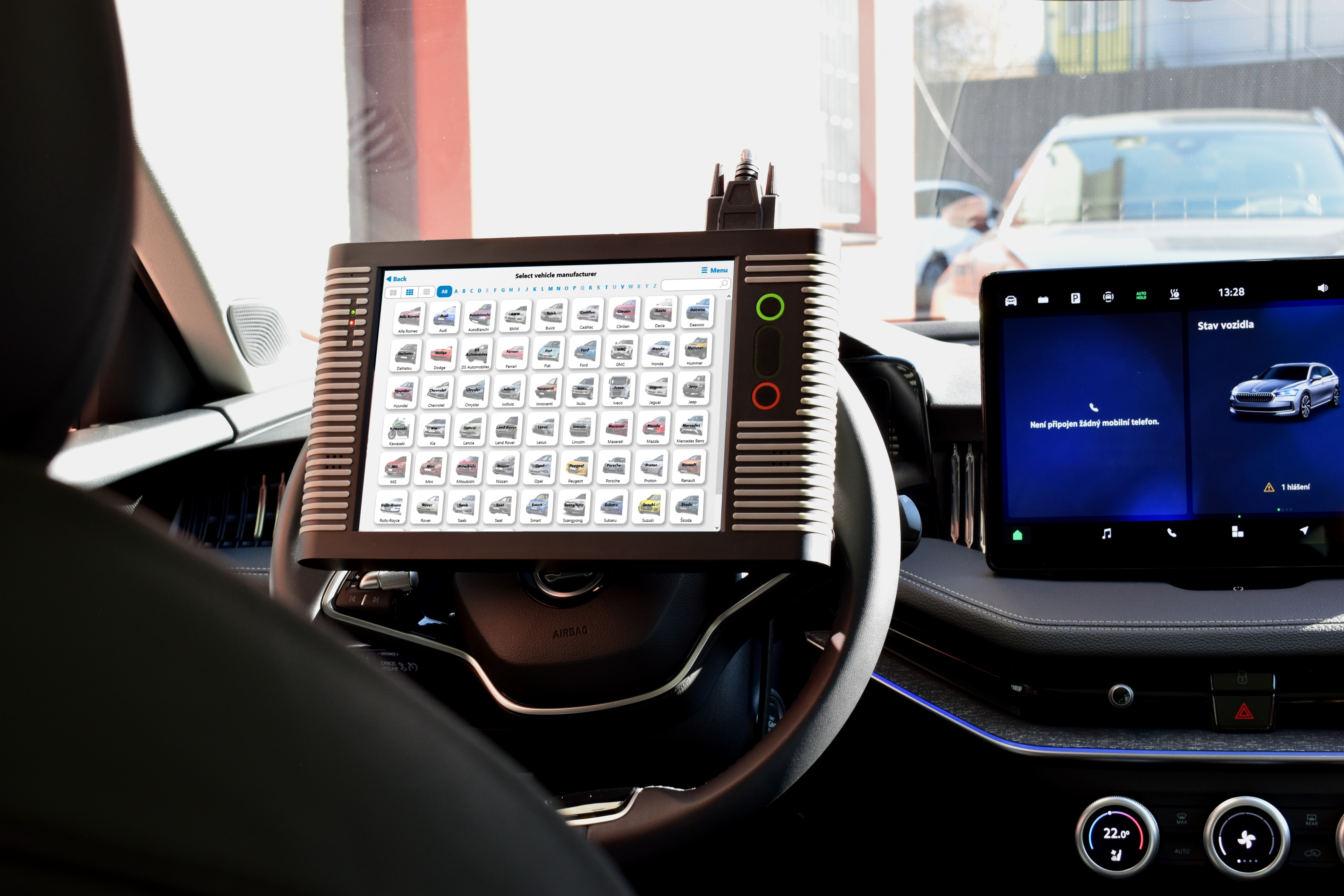
At DevCom, we document continued expansion of ECU identifiers and recognition functions in our diagnostic updates. For some brands, we also explicitly lists automatic ECU detection as a diagnostic capability.
The objective is to identify each ECU variant as reliably as possible. When an ECU cannot be identified unambiguously, the diagnostic application may need to expose multiple known variants for manual selection.

Why choosing the wrong variant may be worse than choosing none
If the tester does not recognise an ECU at all, at least the problem is obvious. The technician knows that something needs to be investigated. If a very similar variant is selected manually, however, diagnostics may begin to work partially. Some parameters may appear. Some DTCs may receive descriptions. One or two service functions may even respond.
This can create false confidence. A variant mismatch may result in incorrect parameter decoding or the execution of a diagnostic sequence created for a different ECU software version. For read-only functions, the consequence may be a wrong diagnosis. For write operations, coding or parameterisation, the need for caution is considerably greater.
“It worked yesterday and it does not today” – what should the workshop do?
The first conclusion should not automatically be “the scan tool is broken”. But neither should the technician assume that an OEM software update must be responsible. Loss of communication can also be caused by ECU power supply problems, CAN or DoIP network faults, gateway issues, SGW/SFD authorisation, replacement of a module, coding changes or an issue with the diagnostic interface itself.
However, if exactly the same vehicle was previously supported by the same diagnostic system, particularly if it has since visited an authorised workshop or received an OTA update, a new ECU software variant is one of the possibilities worth checking early.
The useful information is not merely the vehicle model. It is the full ECU identification: hardware number, software number, software version, calibration identifiers where available and VIN. If a previous scan exists, comparing the ECU identification before and after the problem can be particularly useful. And when the diagnostic database genuinely does not know the new variant, this information is exactly what developers need
Why technical support matters much more than it appears
This is a good example of why technical support on a modern diagnostic system is not simply a help desk for users who cannot find a menu item. A workshop may encounter an ECU software variant released by the vehicle manufacturer only weeks earlier. That is a data-development problem, not necessarily a technician error.
DevCom publicly emphasises its own diagnostic database, regular updates and technical support for the TSPro and Troodon systems. Our support process specifically asks customers to provide detailed descriptions when reporting diagnostic problems.
In this type of situation, contacting support with the VIN, ECU identification, hardware and software numbers, screenshots and any information about a recent dealer or OTA update is therefore extremely valuable. Those details can help developers identify a new variant and update the diagnostic database accordingly.
Real-world reports show that the problem is not purely theoretical
Professional forums contain examples where unusual or updated ECU software resulted in an ECU variant no longer being recognised correctly.
A case published on MHH Auto describes a Mercedes-Benz W205 where, following an engine ECU software update, the ECU variant was no longer recognised correctly by XENTRY and aftermarket diagnostics. This is a single community report rather than an official OEM technical bulletin, so it must not be treated as proof of a general rule. It does, however, illustrate the type of problem discussed here.
Other forums likewise contain cases where diagnostic data had to be updated or supplemented before the correct descriptions and functions for a particular module variant became available. Again, these are practical reports, not evidence that every vehicle software update will create a diagnostic problem.
Modern diagnostics is therefore a living database
This may be the most important point of the entire topic. A professional diagnostic tester is not a finished instrument in the same sense as a multimeter. The hardware may remain useful for years, but the diagnostic dataset has to evolve together with the vehicles.
A new model arrives and new ECUs appear. A new model year arrives and new variants appear. An OEM releases a software measure and another software version may appear.
This is why professional diagnostic updates matter. They are not only about adding another vehicle name to the menu. Much of the work happens underneath the interface: identifying control units, mapping software variants and making sure that DTC descriptions, measured parameters and service procedures correspond to the software actually running inside the vehicle.